
Begin with the crossing
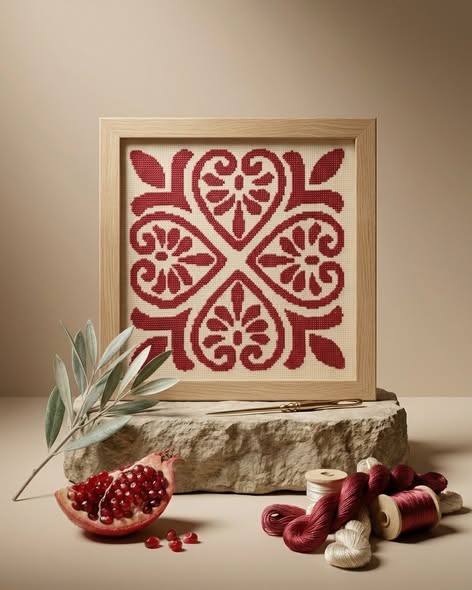
The light crossing divides the four large forms without separating them into unrelated pictures. Its arms widen towards the edges of the central area, giving each red outline a clear neighbour. Look at the centre in a small version of the photograph. The division stays readable even when the detail inside each form becomes harder to distinguish. It gives the whole composition a stable starting point.
One form, four directions
Compare the upper unit with the one to its right. Similar rounded outlines and inner floral marks return after a turn. This rotation sends the eye around the centre rather than simply across the page. The arrangement looks balanced in the photograph, but balance is a visual relationship, not proof that every stitch or interval is identical. Each turn contributes to the larger rhythm.
Curves within curves
Inside the broad outlines, smaller red curves and petal-like marks create another layer of movement. They keep the rounded units from reading as empty containers. Notice the difference between the strong outer silhouette and the more broken detail inside. The outer shape is easy to grasp from a distance, while the interior rewards a slower look. These two scales of detail allow the eye to move in and out.
Leaves lead towards the square
The corner leaves bridge the rounded pattern and the straighter edge of the square frame. They occupy some of the remaining light space without filling it completely. Imagine leaving only the four main units: they would seem more concentrated at the centre. With the corner forms included, the pattern spreads outwards. This describes their compositional role without assigning a village origin or a traditional meaning to them.
See what the red carries
Red holds most of the visual weight against the light ground and pale surround. The olive branch, pomegranate and thread in the styled scene repeat or soften parts of that colour relationship, but belong to the photograph’s setting. Looking at the frame alone reveals a simpler structure: repeated red curves, a light central opening and a quiet square edge. That is the pattern’s own balance.