
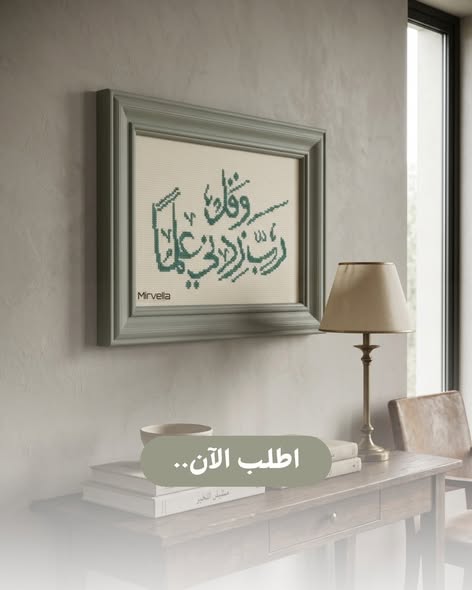
Name the part you do not want to change
Decide whether the words, the dimensions or the visual mood are your priority. Suppose you want a family name in a narrow space: the text and the available width are fixed, while the arrangement of letters may need flexibility. If a decorative composition matters most, a longer inscription may work against it. Explaining which element comes first helps a maker assess the request without having to guess which compromise you would accept.
Write the text before discussing ornament
For lettering, supply the exact text with spelling, spacing and any punctuation you want retained. Names deserve particular attention when they have more than one accepted spelling. Keep a translation alongside the Arabic if someone approving the piece does not read it. Then consider how much text the composition must hold. A short name, a full sentence and several names call for different arrangements; shrinking everything is not always a satisfying solution.
Describe relationships between colours
Rather than requesting the exact colour in a screenshot, describe what it should do: a warm accent against a pale ground, or quiet tones beside dark wooden furniture. One room photograph and one design reference are often easier to interpret than a large folder of unrelated images. Explain what you like in the reference—the border, the spacing or the contrast—so it communicates a direction rather than an instruction to reproduce another person’s work.
Leave space for a workable proposal
Include the outer size your wall can accommodate and any occasion date. A maker can then tell you which parts are possible and what would need to change. If a sketch or text approval is offered, check exactly what it covers and when changes must be settled. Keep the agreed wording and design choices together. A clear brief should reduce ambiguity without pretending that every preference can be combined in one piece.